
Battery Connector Cross Reference & Alternative Sourcing
Compare battery connector candidates using original part numbers, drawings, mating geometry, PCB footprints and operating requirements. Explore the Kangsheng catalog.
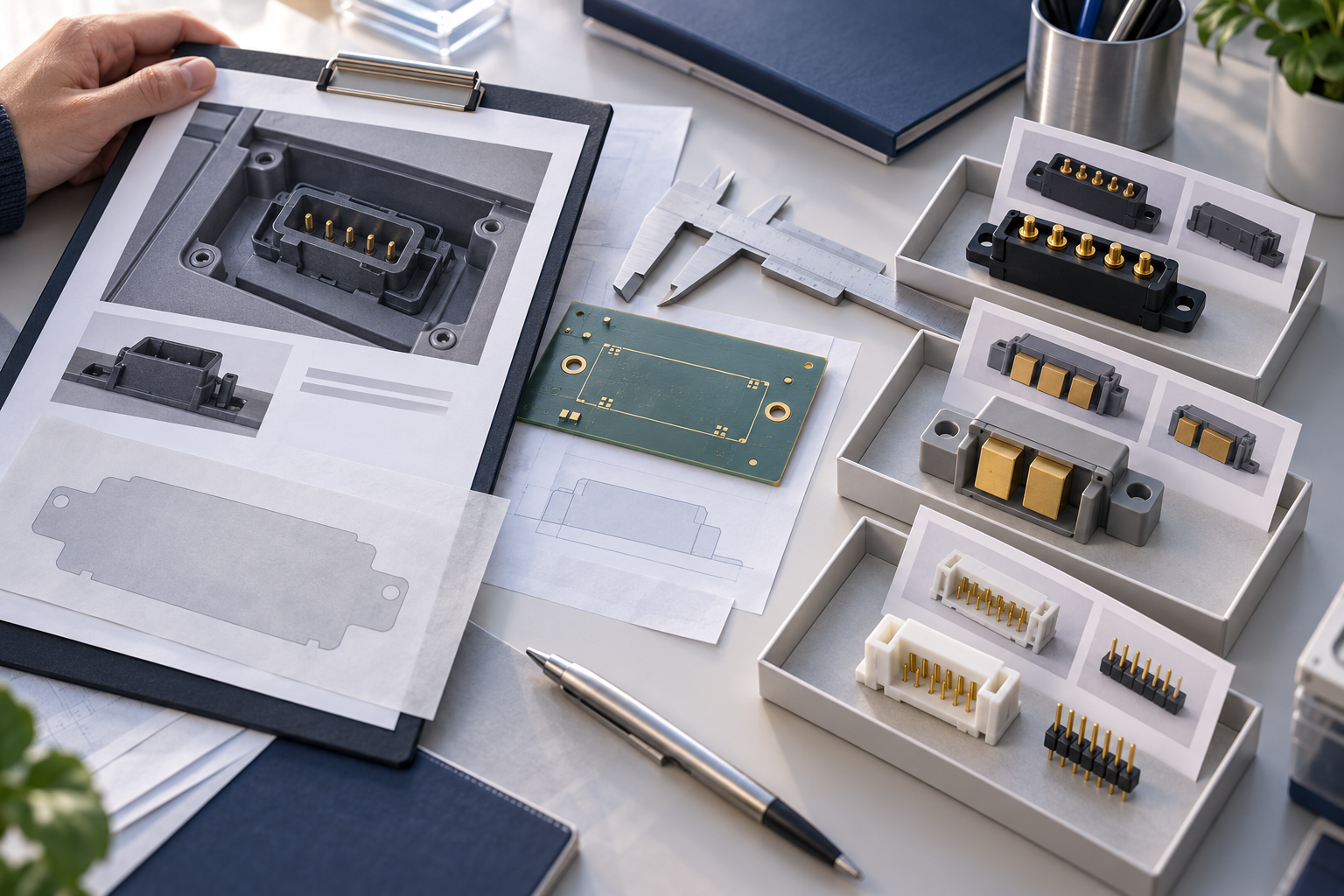
01 / CROSS REFERENCE DIRECTORY
Original-Part Review and Candidate Catalogs
Use the original brand or interface type to organize a drawing review and explore related product catalogs. Select candidates using the full original part number, drawings and application conditions, then plan assembly and operating tests.
| Original Brand / Interface | Structural Review | Requirements and Documentation | Related Kangsheng Catalog | Information to Prepare |
|---|---|---|---|---|
| MolexOriginal part number and drawing | Contact form, center pitch and mounting direction | Working height, contact force and PCB footprint | Spring battery connector catalogFilter candidates by the original contact structureSelection reading: battery connector drawing comparison | Collect both drawings and compare the mating interface |
| TE Connectivity / AMPOriginal part number and drawing | Contact direction, center pitch and installation space | Working travel, contact position and current profile | Spring battery connector catalogCompare top-press or side-press contact structuresSelection reading: BMS and energy storage interfaces | Compare deflection limits and mating contact positions |
| Hirose / JSTOriginal part number and drawing | Pin count, pitch and mating structure | Mating depth, contact sequence and retention | Blade connector catalogFilter by mating-side and PCB constraintsSelection reading: battery connector drawing comparison | Compare insertion depth, guide features and terminal positions |
| Power tool battery interfacesTool platform and battery pack drawings | Power terminals, signal contacts and guide rails | Continuous and peak current, blade dimensions and thermal tests | Blade connector catalogCompare power and signal terminal layoutsSelection reading: blade connector temperature rise | Provide guide-rail and mating drawings plus the load profile |
| DC power jacksOriginal part number and mating plug | Center pin, barrel and solder-terminal layout | Polarity, switching contacts, voltage and current requirements | DC power connector catalogCompare interface dimensions and terminal layoutsRelated reading: switch operation and travel | Compare PCB holes, contact functions and the mating plug |
| C&K / ALPS AlpineOriginal switch part number and drawing | Mounting, terminal layout and actuator shape | Circuit function, operating force, travel and life requirements | Slide switch catalogCompare installation space and circuit functionSelection reading: slide switch review points | Provide switch drawings, operating requirements and PCB layout |
| Amphenol / TE ConnectivityOriginal USB part number and sealing drawings | Pin functions, mounting and enclosure aperture | Data protocol, power requirements and enclosure sealing tests | USB connector catalogCompare interface structure and device requirementsSelection reading: Type-C sealing structure | Provide enclosure geometry, sealing design and test conditions |
| Rosenberger / Mill-MaxOriginal contact part number and drawing | Probe layout, mating surface and magnetic structure | Working compression, contact force and current profile | Pogo pin contact catalogCompare spring-loaded contact structures and installation spaceSelection reading: pogo pin and magnetic contacts | Compare working compression, mating materials and switching conditions |
02 / VERIFICATION STANDARDS
Four Engineering Verification Standards for Alternative Sourcing
Cross-referencing connectors requires verifiable electrical and mechanical tolerance data rather than visual estimation:
Pitch and PCB footprint
Compare original and candidate drawings using the same datum: center pitch, pads, locating posts, mounting direction and tolerances. Include the existing mating part when replacing only one side.
Contact travel and force
Review free height, working compression, travel limits and force curves against the assembly tolerance stack. Plan durability tests around the actual motion, cycle frequency and environment.
Current profile and thermal tests
Record continuous and peak current, peak duration, simultaneously loaded contacts, wire or PCB copper details and ambient temperature. Compare test records under matching conditions.
Material records and soldering conditions
Compare the bill of materials, material reports and soldering process requirements, including insulation, plating, reflow profiles and applicable test documentation.
03 / REVIEW CHECKLIST
Before requesting an alternative battery connector
What is the sourcing goal?
Availability · second source · revised design
View review points
Tell us whether the original part is discontinued or difficult to source, you need a second source, or you are selecting a connector for a revised design. Include your expected quantity and target date. Available models, pricing and lead times require separate confirmation.
What must remain unchanged?
Existing mating part · PCB · mounting
View review points
State whether the existing mating part, PCB and mounting position must be retained, or whether both connector halves and their mounting arrangement may change. Distinguish replacing one side from selecting a new pair. Mark unknown items as “to be confirmed”.
How should a preliminary candidate be used?
Individual comparison · drawing · documentation
View review points
Record differences in pinout, contact positions and mounting dimensions for each candidate. Check samples against the project requirements before choosing the purchasing part number.
Use the existing selection-information checklist to organise available information, then contact us using the details on this page.
Confirm against the specific model documentation
Check the part number, drawing revision, pinout and mounting dimensions.
From original information to candidate review
- 01
Identify the original and your goal
Share the original reference, drawing and application, and explain the sourcing goal.
- 02
List fixed constraints
Distinguish one-side replacement from a new selection, and review dimensions, mating side and mounting.
- 03
Compare candidates and confirm documentation
Preliminary candidates are for comparison; confirm the specific model and documentation before discussing purchasing.
04 / FREQUENTLY ASKED QUESTIONS
Frequently Asked Questions about Connector Cross References
Where should a search for an alternative to a Molex or TE connector begin?
Start with the complete original part number, drawing and mating-part information. Select candidates by mounting dimensions, contact functions, electrical requirements and test conditions, then compare them and validate the assembly under operating conditions.
What engineering information is required to find an alternative battery connector?
Provide the original part number, pin count, center pitch, working height, continuous and peak current, and whether the mating interface and PCB can change.
How should original and candidate current capability be compared?
Compare temperature-rise and contact-resistance test records at the same ambient temperature, loaded-contact count, wire or PCB copper configuration and load. Include peak-current duration and repetition rate.
What information helps when no catalog model fits?
Identify the mating part, PCB, enclosure space and contact functions that must stay fixed. Share adjustable dimensions, expected quantity and timing to discuss design options and samples.
How are sample timing and documentation confirmed?
Include candidate part numbers, quantity, drawing or model formats and the requested arrival date in your enquiry. Confirm the sample plan against stock, fabrication and documentation availability.
Start a discussion with your drawing or part number
Share your original part number, PCB footprint, mating geometry and application conditions to discuss candidate models, documentation and sample arrangements with Kangsheng.